


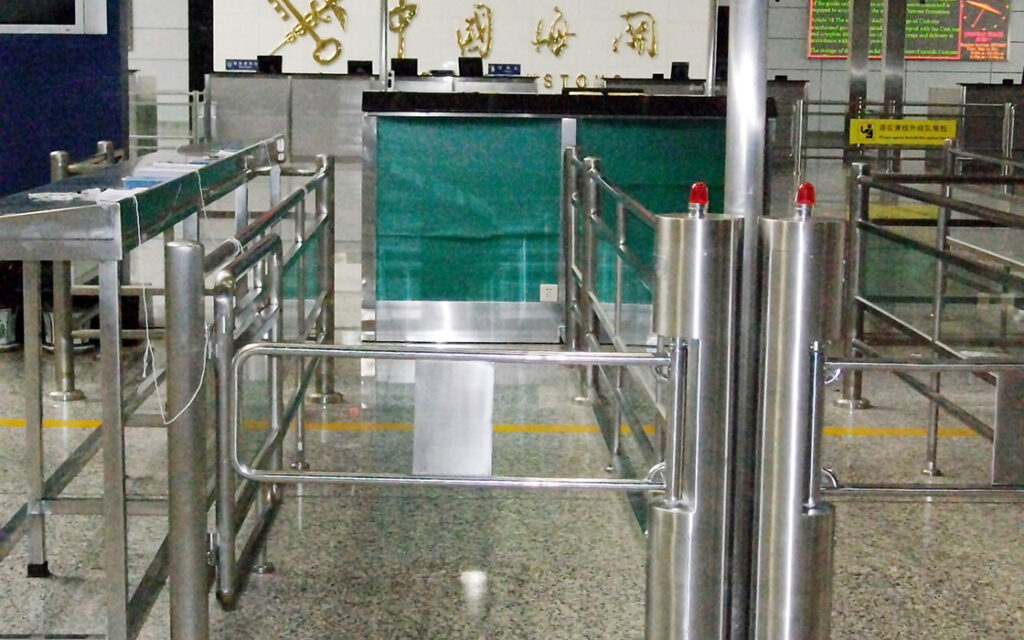
Chinese customs checkpoints are a special case. The security here must be airtight, but the environment also needs to project a sense of national prestige and calm efficiency. You can’t just put up a rusted iron gate and call it a day. The equipment, including the turnstile, has to look the part. That’s why the Cylindrical Swing Turnstile is showing up more and more in these specific pedestrian lanes.
It’s a shift in how we think about access control at national borders. The cylinder design is modern; it’s sleek. It communicates that this is a modern, tech-forward country. But this is more than just a pretty face. The engineering inside is where the real value is. These swing gate mechanisms are designed to handle extremely high throughput during peak travel seasons. They need to open fast, verify the traveler’s identity—often through a combination of passport scanning and biometrics—and close just as quickly. The challenge at customs is not just controlling access but managing the flow of anxious travelers. The mechanical structure of the cylinder swing gate allows it to be integrated with sophisticated access control systems, including QR code scanners for self-service lanes and facial recognition cameras. It’s a physical deterrent that works in perfect harmony with the software. The build quality is critical here; it needs to be robust enough to resist tampering and durable enough to operate for millions of cycles. For the customs officials, having equipment that looks professional is a necessity for maintaining order and projecting the right image.
Now, think about the actual user experience at a major international airport. You’ve just stepped off a long-haul flight. You’re jet-lagged, your documents are somewhere in the bottom of your bag, and you just want to get through the line and find a taxi. The cylindrical swing barrier gate is one of the first physical things you interact with in the arrivals hall. It needs to be intuitive. You shouldn’t need a manual to figure out where to place your passport or how to scan your boarding pass. The top panel of these units usually features a clearly marked sensor area and a small screen that gives you step-by-step instructions. The swing gate itself is powered by a brushless DC motor, which is quieter than traditional motors and uses less energy, a nice touch when you’re running hundreds of these units around the clock. Another nuance about the cylindrical form factor is that it occupies less floor space than a traditional boxy barrier. In a crowded customs hall, every square meter counts. The rounded housing is also easier to clean—no sharp corners where dust and grime can accumulate. And let’s talk about anti-tailgating. Customs is one of the highest-risk areas for people trying to slip through behind someone else. These cylindrical Swing Gate Turnstiles are equipped with infrared sensors that track the movement of a single person through the lane. If a second set of feet is detected within a certain distance, the gate will immediately try to close, and an alarm will alert the nearby officers. It’s a robust system that adds an extra layer of security without relying solely on human vigilance, which can waver after hours of watching a monotonous stream of passengers.